As Design Lead with an open brief, I guided a small team of writers and designers to identify the highest‑leverage improvements across information architecture, content clarity and guided support.
First, I established a compelling vision & purpose. Through workshops with IT leadership and service owners we co‑created clear statements that articulated why great self‑service matters (faster task completion, reduced interruption of work, higher employee confidence). These statements became visible artefacts in our space and systems and anchored prioritisation.
We translated the vision into measurable OKRs & metrics: reduction in service desk demand (where self‑serve existed), reduction in knowledge article read / dwell time, and increased helpfulness ratings.
Field observation and usability studies of the legacy portal showed employees often failed to find answers because navigation labels mirrored internal service owner terminology; success depended on already knowing the “right” search vocabulary.
We ran open card sorts and iterative tree tests to derive a clearer information architecture and content strategy. Usability sessions on clickable prototypes validated that the new structure reduced search retries and misroutes.
Concurrently we defined conversation patterns and redesigned a new advice bot: restructuring dialogs around step‑by‑step guided resolution for the most frequent issues, prototyped and refined with employees.
I produced animated promotional videos for the chatbot (localised in 6 languages) to drive adoption at launch, produced in Adobe After Effects & Premiere Pro.
These outcomes freed IT support capacity for higher‑complexity issues and improved employee task flow continuity.
Establishing vision, restructuring information architecture, designing guided support and driving adoption to measurably shift self‑service outcomes.
- Vision & purpose development
- Team leadership & mentoring
- Integration with ServiceNOW
- OKRs & metric definition
- Information architecture (card sorting / tree testing)
- UX & UI design
- Prototyping & usability testing
- Conversation & content design (advice bot)
- Workshop facilitation
- Multi‑language comms & promotion
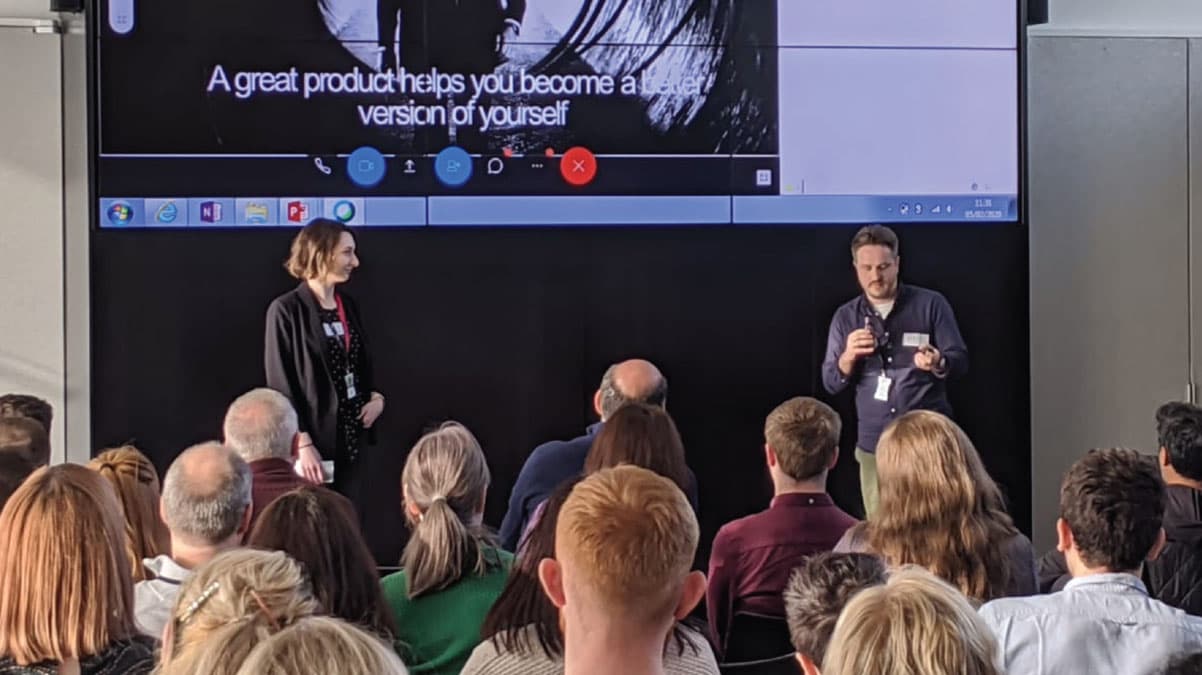
Visible purpose statement aligning the squad and stakeholders on desired outcomes.
Vision articulation helped motivate the team and frame prioritisation discussions.
This is the previous design, which relied heavily on precise search terms and terminology that not everyone was familiar with.
Through usability testing with volunteer employees, we quickly learned and demonstrated that many employees lacked the technical vocabulary to query effectively.
Through the redesign and improved support content, we saw 24% fewer desk tickets, dwell time -25% and increased article helpfulness by 60%→85%
Value Created
Shifted a significant portion of support demand to self‑service: 24% fewer applicable tickets and faster knowledge acquisition (dwell time -25%) while boosting confidence (article helpfulness 60%→85%), enabling IT to reallocate time to complex incidents
More case studies
Creating a transformation movement through holistic design

Customer insight-led product roadmap

Discovery phase for UK licensing and permits

Simplifying home insurance onboarding

Boosting decarbonisation among UK SMEs