Mapping typical licensing journeys to identify common patterns, common pain points and opportunities for improvement and amalgamation.
We worked as one multidisciplinary team (Valtech, Cabinet Office and GDS) to study the opportunity: what problems local authorities, law firms, applicants and end users actually face, and where a shared platform could remove friction or cost.
We began with depth interviews and usability reviews of the existing GDS-operated service. This was a journey that didn't have a dedicated team and had no sustained investment for 8-10 years. We consistently saw outdated journeys, involving manual re-keying across multiple systems and paper-heavy steps that created delays and backlogs across hundreds of local authorities, police administration and outsourced legal services.
Financial analysis and conversations with councils revealed many local authorities were effectively running licensing processes at a deficit: fee income often failed to cover manual administration time.
Across hundreds of authorities and licence types this pointed to a significant optimisation opportunity — if the root causes (manual data re-entry and paper dependencies) could be addressed.
We mapped common and complex end-to-end journeys, highlighting systemic points where information was printed, signed, scanned or retyped. Prototypes and low-fidelity sketches explored flows that removed duplicate data entry through structured data capture and reuse.
However, legal constraints (wet signatures, proof-of-payment artefacts and notarisation requirements) meant core steps still had to be progressed manually. Without legislative change the platform would automate only fragments, leaving the bulk of cost in place.
Given the broader 2017 regulatory landscape (and Brexit-driven legislative backlog), the necessary reforms were unlikely in the near term. We therefore advised deferring large-scale platform investment until enabling regulation could unlock full digitisation.
Discovery and evaluation focused on system mapping, evidencing inefficiency sources and modelling potential value if legislative blockers were removed.
- User & stakeholder interviews
- Usability evaluation of current platform
- Service & systems mapping
- Journey & process modelling
- Low‑fidelity prototyping & sketching
- Workshop facilitation
- Benefits & deficit analysis
- Executive presentation & recommendation
Evaluating the existing licensing journey with representative users to surface friction points.
In our ethnographic research, a paralegal explained how they had to copy information manually from a PDF and re-enter the information into their legal system, MatterSphere. This firm even invested in an additional monitor to make it easier for admin staff, since the bulk of work they did was to rekey TENs (Temporary Event Notices).
We conducted cost analysis across multiple local authorities to understand the financial impact of the licensing process. This was significant for larger and more urban authorities.
To understand more about licensing challenges, we explored how different departments rely on each other to issue licenses and how they all have different, important objectives.
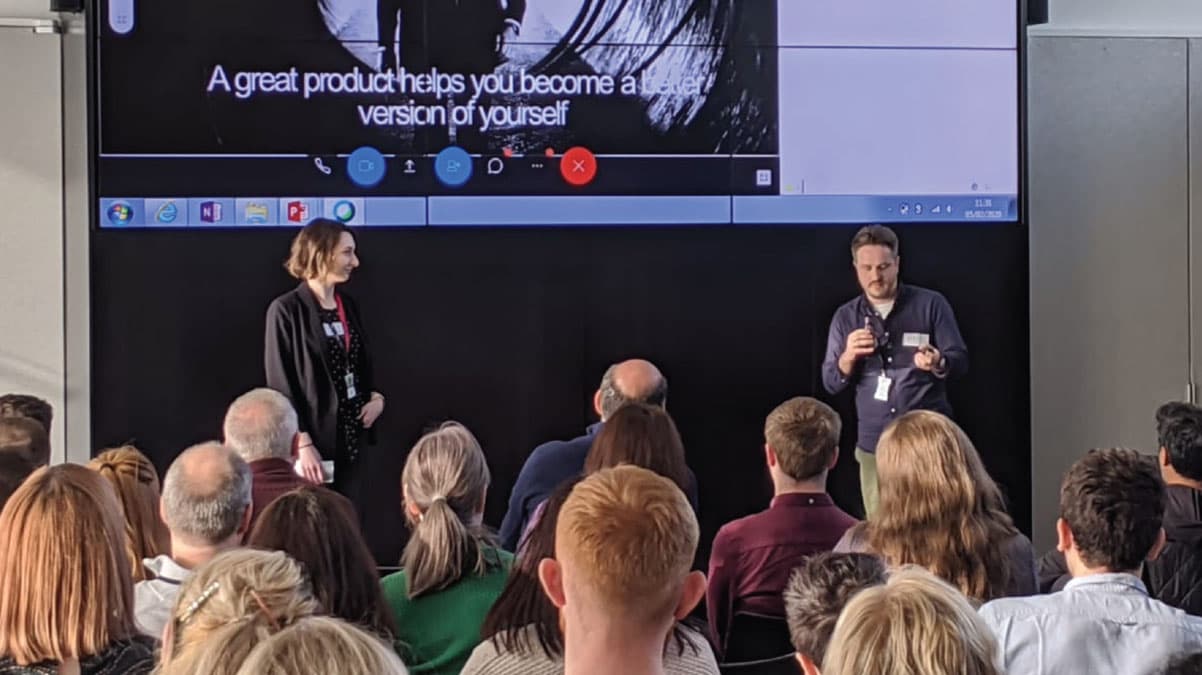
Here I'm talking through our journey map. Credit: Mark Hurrell
My low-fidelity sketches to explore ideas for improving the licensing process.
Value Created
Provided an evidence-based recommendation to pause major build investment; clarified legislative dependencies; surfaced primary cost drivers (manual re-keying & paper validation); established design hypotheses and prototype flows ready for acceleration once regulation changes
More case studies
Creating a transformation movement through holistic design

Customer insight-led product roadmap

Simplifying home insurance onboarding

Redesigning global IT self‑service to drive productivity

Boosting decarbonisation among UK SMEs